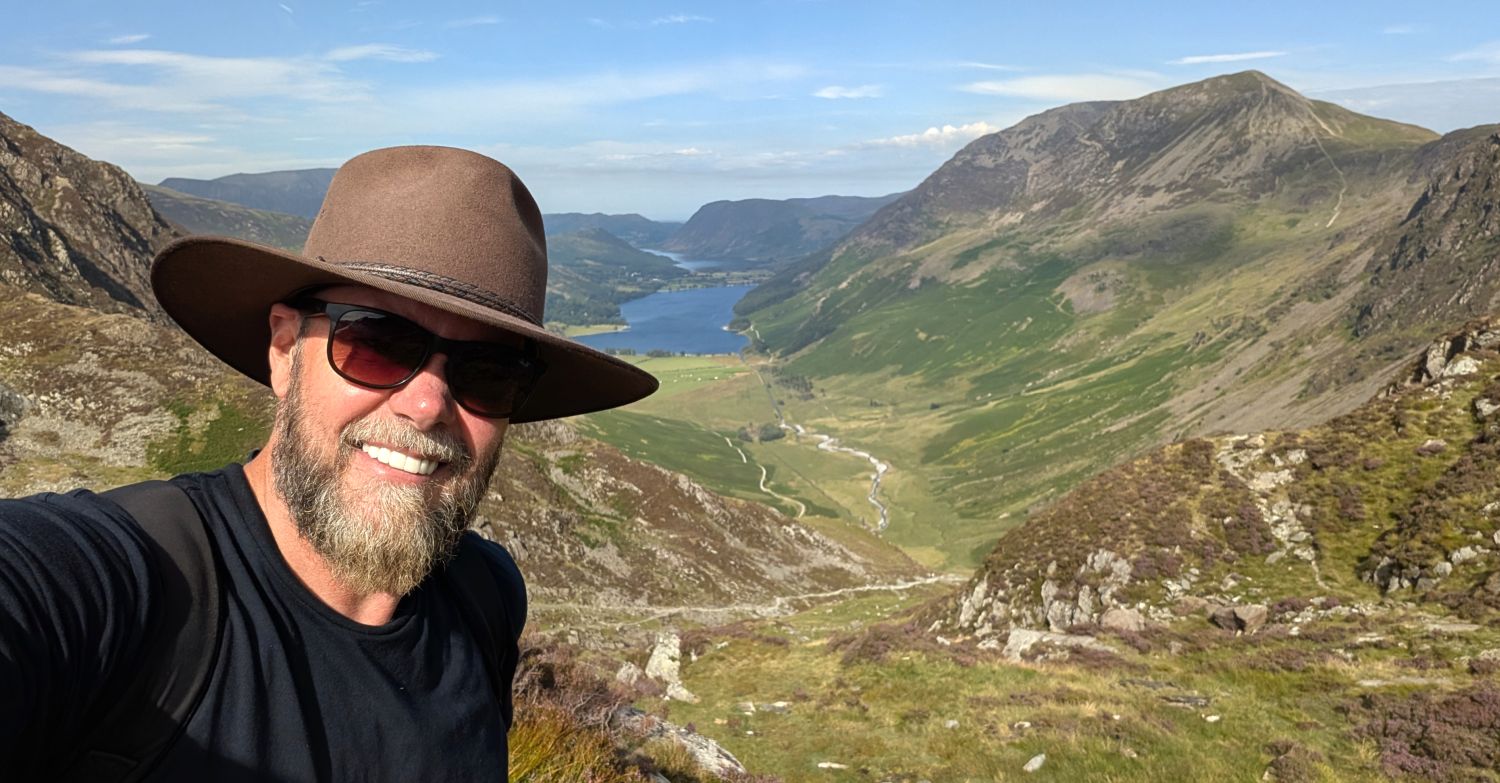

A regular visitor to the Lake District, Brenden has developed a deep affection for its fells, valleys, pubs, people and allegedly existent red squirrels. In this piece, he reflects on what keeps drawing him back to this very strange and wonderful corner of England.
A Very Strange Place
Bogs, false summits, mythical squirrels and one Australian’s unlikely love affair with the Lake District
As an Australian, I arrived in the Lake District with a few assumptions. I had been reliably informed that Britain had no snakes, the weather was generally mild, and a “moderate walk” was something a reasonably fit bloke could complete without having to renegotiate the terms of his relationship with gravity.
All three statements have since proven questionable.
Britain may not have many snakes, but the Lake District has miles of exposed tree roots, wet bracken, loose stones and stick-shaped objects lying across paths. To an Aussie brain, anything long and brown deserves at least three seconds of careful consideration. I have crossed entire fields confidently enough, only to leap sideways because a twig looked mildly ambitious.
The walking descriptions are not much more reliable. After several visits, countless miles and extensive field research conducted from both fells and pubs with suspiciously friendly locals, I have discovered that Cumbria has developed its own language. It sounds like English, but many of the words appear to have quite different meanings.
A “moderate walk”, for instance, means you will begin questioning your cardiovascular fitness within twenty minutes. “Just over that ridge” means there are at least three more ridges, none of which were visible when the statement was made. And when a local tells you it is “not far now”, this should not be interpreted as a measurement of distance. It is more of a spiritual encouragement.
Even the forecast gets involved. “Lovely day for it” generally means the rain is only coming from one direction. The Lake District treats forecasts less as promises than as creative suggestions. You can leave the car park in sunglasses, put on a waterproof halfway up, lose all visibility near the summit and return with wet socks, mild windburn and a completely different understanding of the word “summer”. The locals describe the weather as changeable. I would describe it as meteorological speed dating — sunshine, rain, wind and fog, each appearing briefly before deciding it can do better.
Yet I keep coming back.
I have walked on Binsey and Latrigg, wandered through Whinlatter and made my way across Barf, Lord’s Seat and Broom Fell. I have stood above valleys that looked painted into the landscape, followed paths that gradually became theories and discovered that a “local shortcut” is often an invitation to stand knee-deep in a bog wondering where your life went wrong.
Broom Fell provided one such education. Lakeland bogs do not announce themselves. There is rarely a helpful sign saying, “Australian visitor, place your entire foot here and immediately regret it.” They wait beneath an innocent patch of grass, confident that sooner or later somebody wearing clean boots will come along.
One moment you are striding through the countryside feeling connected to nature and faintly heroic. The next, one leg has disappeared into Cumbria, your walking companion is trying not to laugh, and you are performing a complicated movement that is part escape attempt, part contemporary dance.
Walking is very good for the ego in that respect. Mountains have little interest in who you think you are. They do not care about your job title, your problems, your postcode, or whether you bought the more expensive waterproof jacket. They simply present the slope and let your knees discover the truth.
The roads are equally committed to personal development. Driving through the Lakes involves placing an extraordinary amount of trust in a strip of tarmac apparently designed when horses were narrower. Newlands Pass has a way of concentrating the mind. The narrow road winds upwards between the fells, past Moss Force, with views that would be easier to appreciate if you were not simultaneously negotiating with an ambitious motorhome coming the other way.
At certain points, you edge forward between stone walls, watching an approaching vehicle grow steadily larger, while both drivers participate in the ancient British ritual of pretending there is definitely enough room.
Somehow, there usually is.
The valleys below offer a different sort of experience. Buttermere, Borrowdale and the quieter corners around Newlands do not simply sit beneath the fells — they seem to hold them. Farms rest beneath the slopes, stone walls cross the land, and old paths rise towards the passes, carrying the marks of lives lived here long before any of us arrived with hydration packs, GPS watches and strong opinions about merino wool.
It is easy for visitors to see the Lakes as scenery. We admire the dry-stone walls, photograph the sheep and describe the rain as atmospheric because we know we can eventually retreat to a heated pub. But this landscape has been worked as well as admired. People have farmed the valleys, quarried the stone, crossed the passes and built lives beneath weather that has never shown much interest in visitor satisfaction.
That lived history gives the place its character. The Lake District is not merely a beautiful backdrop for our adventures. It has its own pulse, shaped by work, weather and generations of people who learned long ago that complaining about the rain achieves very little.
The people are part of what keeps drawing me back. The more often I return, the more I notice the quiet ways people connect. Strangers speak as though we have met before. Gates are held open. Route advice is freely offered. The weather is discussed with the detailed seriousness usually reserved for international diplomacy.
On a fell, nobody seems especially interested in status. You are judged mainly by whether you close the gate, move aside when someone needs to pass, and possess anything edible when another walker has underestimated the length of the route.
There is also something deeply humbling about being overtaken uphill by a cheerful pensioner who continues an uninterrupted conversation while you are breathing through every available part of your body. They pass with a pleasant “morning”, stepping lightly upwards as though popping to the kitchen, while you attempt to reply without sounding like an accordion being thrown down a staircase.
The pubs are an important part of the experience, though officially they should probably be classed as recovery facilities. A “quick pint after the walk” can involve three hours of route analysis, sheep discussion and recommendations for pubs you have somehow missed despite visiting six times already. By the second pint, someone will produce a map. By the third, tomorrow’s gentle recovery walk will have acquired two summits and a section described as “a little steep in places”.
This, I have come to understand, is the Lakeland Way. Not simply a route, but something closer to an unwritten agreement about how people treat each other out here. The walking matters, but so does what happens around it — the nod exchanged with a stranger on a path, the person who waits while somebody catches their breath and pretends they only stopped to admire the view, and the conversation in a pub that starts with the weather and somehow ends with two people telling each other something true.
Connection here rarely announces itself. It simply happens, the way the rain does.
Not every walk has ended with a summit. On one visit to Buttermere, I set off towards Red Pike and High Stile with the confidence of a man who had looked at a map and therefore considered himself informed.
Maps are wonderfully calm documents. They show contour lines in neat, harmless circles and never adequately communicate the moment your legs begin negotiating directly with your brain. The valley looked magnificent below me — the lake, the farms and the buildings shrinking as I climbed. From that height, the landscape seemed peaceful and perfectly arranged.
My lungs held a slightly different opinion.
I reached roughly 640 metres before deciding to turn back. The scree above looked impassable on this occasion.
The old version of me might have called that failure. We are often told courage means pressing on, reaching the top and collecting the photograph. But the mountain did not see it that way. It did not mock me or issue a statement questioning my masculinity. It simply waited.
A steep climb does not pretend to be flat. A bog does not hold a meeting about your suitability before swallowing your boot. The rain may arrive uninvited, but at least you know where you stand with it — usually somewhere damp.
That is more honesty than much of life offers, including a fair bit of it I had spent years trying to prove my worth to.
The summit is still there. I will go back for it when the day is right, and not before.
Now, the delicate subject of wildlife…
Despite multiple visits, countless miles walked and what I consider a reasonable level of commitment to the cause, I remain unconvinced that red squirrels exist. Every local knows exactly where to find them.
“You’ll see loads around there”, they say, with the relaxed confidence of people who are clearly participating in something.
I then spend several hours creeping through woodland like an Australian David Attenborough, inspecting every branch and reacting to falling leaves.
Nothing.
Plenty of grey squirrels, mind you — they make no attempt to remain mysterious, sitting in full view eating someone’s abandoned sandwich and behaving like minor local councillors.
But the red ones remain elusive.
At this point, I suspect they are the Lake District’s answer to the Queensland drop bear — a clever regional myth designed to keep visitors wandering through the woods and spending money in tearooms.
So, I will keep coming back — to the mountains, valleys and narrow passes, to the pubs, sheep and sideways rain, to the conversations with strangers who hold gates for you, and to the suspiciously cheerful pensioners overtaking me uphill without breaking stride.
Not because any of it has fixed me — mountains are not therapists, whatever people in expensive outdoor jackets might suggest — but because out here the rules are simple and nobody is pretending otherwise.
Watch the weather. Mind your footing. Help the person beside you. Turn back when it is no longer safe.
That is the whole of it.
That is the Lakeland Way.
So, if you ever pass a slightly out-of-breath bloke in an Akubra, likely keeping the company of livestock, do say g’day. I may still be searching for the red squirrel, but I have learned that the best part of any journey is often the people you meet along the way.
Very strange place indeed.
And a very special one.
<<>>
Brenden Bolitho is an Australian writer and walker now living in Derbyshire. Through his Walkabout Reflections page, he shares honest observations on life, loss, rebuilding, and the lessons found on long walks — usually with a little Australian humour, a few sheep, and the occasional philosophical rabbit hole. If you’ve enjoyed this article and would like to read more of Brenden’s writing, visit his Walkabout Reflections page.